
The Right System Only Reveals Itself Through Action
3 tips to make sense of contradictory advice

Audio is back! Here’s me reading out this stack:
Timestamps
Part 1: The beginner challenge (0:24)
Part 2: You learn about yourself through action (1:55)
Part 3: Three tips to cut through the noise (6:53)
No AI — I recorded and edited this personally. I’m also playing the piano myself.
PART 1: THE BEGINNER CHALLENGE
The fun about being a beginner is that you make progress fast.
Unfortunately, you don’t know whether you’re progressing in the right direction.
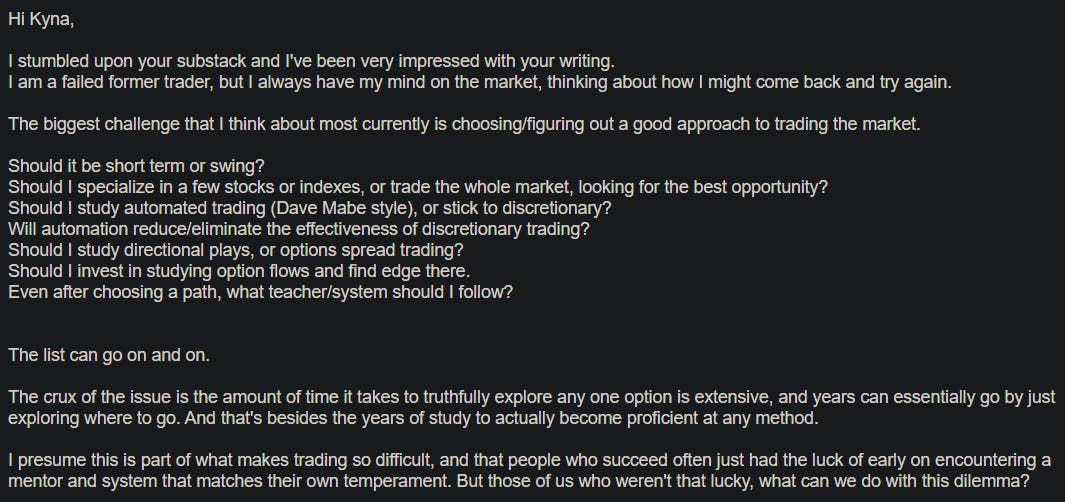
Whichever system you encounter first tends to be the one you adopt — at least, to start with. But sooner or later, you’ll hit your first obstacle.
What now? Did you choose the wrong path? Do you need to take a different route? And if so, which one?
If you chose your first path by chance rather than through deliberate research, your doubts are amplified.
You have zero conviction. And it’s human nature to look at the system rather than yourself as the problem.
The doubts then get worse as you learn about alternative systems, sometimes stating the polar opposite to what you first learnt.
Who’s right?
Both could be. But only one will be right for you.
The million-dollar question is twofold: how you find the right system, and how you know you’ve found it.
Discovering the right approach takes trial and error. I’m a big advocate for just getting started imperfectly, then refining as you go along.
You can get exceptional results if you stick with an imperfect process for long enough, rather than pursue the perfect process you can’t consistently implement. Plus, you’ll naturally make tweaks to that process as you go along. Because by acting, you gather feedback. What works? What doesn’t?
The same principle applies to deciding on the right system to begin with.
PART 2: YOU LEARN ABOUT YOURSELF THROUGH ACTION
By taking action, you uncover the information you need to make the right decision.
My trading journey started with the Covid crash.
Everything was trading ‘at a discount’. My first purchase was a recommendation from my dad. I ended up buying the low and doubling my income for the month with just one trade.
After that, I was hooked.
The story behind that first trade made sense: demand for luxury student accommodation was bound to return, so buy a London-listed REIT that specialises in it. (Its price had tumbled, along with every other stock.)
I tried to find more stocks where I could make a fundamental case for their ‘undervaluation’, so price ‘had’ to come back.
But I lacked a systematic approach, which bugged the hell out of me.
At the time, I was ghostwriting a book about risk management and management systems (in cyber security).
The gap between what I wrote and how I acted weighed on me. My stock-picking and timing ‘methods’, if you can even call them that, felt haphazard. They weren’t consistent or repeatable. And even before the 2020 bull run was over, I knew my luck wouldn’t last.
Then, I learnt about technical analysis and reading price charts.
This made way more sense to me.
Price reflects the truth of supply and demand — whereas I couldn’t ever see myself having an edge by studying financial reports. Not if even qualified auditors could be misled by the information the company wants them to see.
The next step was to find the best resources for this strategy.
I found Mark Minervini’s books, whose methods made sense.
They reinforced my instincts about avoiding ‘cheap’ stocks. Plus, Mark had a verified track record, as did various other traders with a similar style, including William O’Neil, David Ryan and Dan Zanger. This made me feel I was on the right path.
Then, in 2021, I came across Stockbee’s interview with Richard Moglen.
Pradeep shared ideas I’d never heard before, including momentum bursts, episodic pivots (EPs), and misunderstandings around CAN SLIM. That was my first insight into the need for depth, and why textbooks can be problematic.

Pradeep also mentioned a name I’d never heard before: Kristjan Kullamägi.
I looked up Kristjan, then studied his blog, streams and Chat With Traders interview.
Via Chat With Traders, I also learnt about other traders I hadn’t come across before, including Tom Dante, who taught me how to analyse my journal. (Catch up on my last stack to learn how that impacted my trading — and how it can help yours.)
But Qullamaggie was different.
He’d taken the ideas from my early trading influences, and totally made them his own, leading to some of the most impressive returns ever seen. Not only that — he openly shared his trades and thinking, for free, in real time.
(In all likelihood, TTRH wouldn’t be as we know it today if it wasn’t for Kristjan.)
I tried to copy Kristjan’s aggressive methods before realising I don’t have his stomach for volatility.
I simply can’t buy speculative trash, then hang on for the ride — even though I knew this strategy yielded the highest returns…
…but only if you can execute it.
You can spend your entire life learning systems that have proven profitable for others, and not make a dime if you don’t recognise that none of those people have your unique combination of experiences, environment and DNA. Why should the exact blueprint that worked for them also work for you?
You don’t get to decide how lucrative your edge is. You can only choose whether you’ll leverage it, or risk diminishing your edge in your pursuit of greater financial reward.
As Tom Dante puts it: “The edge is in you.”
In this tweet, Tom shared how in his earlier days, he believed you learn to trade by copying what a great trader does. Sounds reasonable, right?
…except he then watched a brilliant trader put in a big order, get filled, and immediately get out. Tom’s response: “I was dumbfounded. Price literally hadn’t moved.”
So, why did this trader get in and out at the same price?
Because he could tell by the way his order filled that the price was going to move lower. In Tom’s words: “This ledge had made millions but I realised that kind of trading just wasn’t me. I wasn’t able to process that kind of information from the T&S [time & sales] and react quick enough.
“Could I have learnt it? Possibly. But I am patient and methodical and those traits didn’t sit well with that style of trading.”
PART 3: THREE TIPS TO CUT THROUGH THE NOISE (AND NAVIGATE CONTRADICTORY ADVICE)
1. Pay attention to the messenger.
Start with the people who walked the path before you: who has done what you want to achieve? Particularly in the markets, track records matter.
But a range of strategies have a theoretical edge that wouldn’t necessarily play out for you due to a mismatch in personality or lifestyle.
You can learn a ton from people with a different strategy to you. Heck, you can learn from anyone who has figured something out — even if it’s in another field entirely.
Just be aware that these differences are the most likely reason behind conflicting advice.
To quote Brian Shannon:
“Most arguments on 𝕏 come down to participants having different timeframes.
“Timeframe choice is vital. Your rules of engagement are largely a downstream effect of your timeframe, which you choose based on your risk tolerance and reaction time.”
(The full article — which I helped Brian write — explains how to choose the right timeframe for you, outlining the pros and cons of different timeframes, along with a list of questions to ask to help figure out yours. This is the content I wish existed, preferably years ago.)
So, don’t automatically put more weight on the person with the most impressive track record.
Pay attention to how much their personality, lifestyle and goals align with yours.
Because chances are, the more you can relate to the person, the more directly you can apply their methods, lessons and insights. (Not a guarantee. Just probabilities.)
Remember to also pay attention to the person’s track record as specifically a teacher or mentor. Not everyone who can do, can teach.
Even if your teacher can ‘do’, they can’t necessarily do it as well as their top students.
In this previous stack, I discussed mentors. My dad added that top snooker players (and other sportsmen) have a coach who, even at their peak, was never quite as good as their current client — yet they still add value.
I had the same experience with piano teachers. My first teacher gave me a solid technical foundation that continues to serve me well. As a concert pianist, she clearly can ‘do’, way better than me.
But the teacher I made most progress with (another Brian) only started doing anything professional with music in semi-retirement, just two years prior. Piano was his second instrument. And when I started with him, we were at about the same level as pianists — then surpassed him within months. (Full story and recording.)
The best teachers and mentors make you fall in love with process.
They don’t fixate on the outcome, but help you eat the elephant one bite at a time.
They inspire you to explore your curiosity, which brings out your strengths.
And they encourage you to focus on small, daily improvements — because while the results will never be perfect, they can be better than you believed possible.
Brian didn’t once dream of becoming a professional musician, then had to teach because he couldn’t make a living from only playing. He just had a lifelong love for music, which drove him to do it professionally (part time) in semi-retirement when he was up for a new challenge. He was constantly learning and figuring things out alongside me, and passed on that curious mindset and love for practice to me.
Plus, he encouraged me to develop my own style, rather than adopt his.
2. Look for commonalities.
The more different traders I come across, each with a different timeframe and different tolerance for volatility, the more I focus on the commonalities. (And I pay extra attention when I see them across different fields.)
Because if all the good ones are doing it?
I should probably follow suit — at least to start with. Because it hints at a principle foundational to the field, and maybe even to greatness in general, that I too must adopt and make my own.

In “5 Lessons From Top USIC Performers”, for example, I shared what I kept seeing across the people I’ve worked with or studied (in spite of all their differences), from the absolute priority on risk management, to extensive preparation and depth of study.
Qullamaggie and Stockbee also both emphasised the need for a deep dive.
Specifically, by studying thousands of examples of your setup and building a database. (Here’s a step by step.)
But that’s just one method.
Both men insist on it because this worked for them, and they’ve seen it work for others. (Mark Minervini and William O’Neil, for example, did versions of it.)
Plus, they get asked endless questions by people looking for shortcuts that don’t exist.
Telling people to go and look at a few thousand charts is a clear way of saying they haven’t done enough work of their own yet.
Because when you start focused chart-flipping in high volume, your understanding of market structure deepens — something you need regardless of the system that turns out to be right for you.
Unless you have some very interesting connections, your edge needs a basis within the reality of market structure.
Understanding that structure allows you to refine that edge — like knowing when it doesn’t or barely exists due to a poor environment.
3. Find what resonates — and articulate why.
Earlier, I said that Qullamaggie is different. Not just in his performance or generosity, but in his transparency about the work ethic it takes to achieve truly outlier results.
I don’t just mean the time and effort commitment.
I mean the need to verify everything for yourself.
Everyone goes through an exploratory phase, when contradictory ideas feel most overwhelming:
Discretionary or systematic?
Trend-following or reversal trading?
Selling into weakness or selling into strength?
That’s far from an exhaustive list, but it makes the point:
Understand the pros and cons of each.
When you first learn about an idea, it’s probably from someone biased about it.
You’ll be told what it is — or rather, how that person understands it — and why it’s either great or terrible.
Perhaps you’ll take the person’s word as gospel based on their results. (At least, the visible and measurable ones. But ‘success’ means different things to different people.)
Always remember: what works for someone else doesn’t automatically work for you, and vice versa.
The potency of an idea depends not just on the technique or system itself, but also on how well it aligns to that person’s strengths, character and circumstances.
You can’t establish this without grasping the ‘why’ and ‘how’ behind the idea.
Otherwise, how will you determine to what extent the idea reflects the reality, and to what extent it reflects another person’s cognitive process? How can you figure out whether the idea and associated processes add value to your strategy?
You’re looking for ideas that resonate, but not based on the messenger or instinct alone. Be able to articulate why an idea works for you, and seek evidence that backs up or refutes this assertion (such as via your own stats or studies).
Without depth, you only have a preference or, worse, a soundbite. Not conviction.
Once you have conviction in an idea — most likely because you’re getting early signs you’re doing something right — you double down.
You stop chasing more information, and commit to acting on the information you already have. Ironically, that’s how you get better information on how to keep refining your skills and processes. Results follow commitment. Not vice versa.
In the end, whoever you end up learning from, their teachings will only ever be a starting point. You must ultimately make them your own.
The edge is in you.
- Kyna
P.S. Not specific to trading. It took me six years to figure out the edge is in me as a writer, too. I’m sharing the story on A Trading Writer’s Diary next week.


Hi Kyna - Very nice article and beautifully written. Points you have mentioned are very true and it took me a long time to settle on one timeframe and accepting a fact that even if I was handed over a profitable system doesn't mean I will be profitable too. I definitely have to make it my own and tailor it according to my personality, risk appetite, time I can allocate to market and so on.
I now trade off daily timeframe, made my charts clear by removing indicators I don't use, do 45 mins to 1 hour of analysis after market close, etc.
During the weekend I do more in depth analysis of sectors, review my journal, course correct if I am deviating.
I also now know that doing all the above won't necessarily make me profitable but I think that atleast this is THE path to profitability which provides me the conviction to put in the work.
Thank you Kyna, for another great article, as always.
Enjoyed every words you wrote and your voice!