
The Advantages of Part-Time Trading
Trade from a position of strength

“I went from mediocre to a stellar performer when I told myself: To heck with worrying about the money and obsessing over the scoreboard.
“I’m just going to focus on being the best trader I can be and sticking to the rules. Then the money followed.”
Mark Minervini, Think & Trade Like a Champion.
Pursuit of mastery requires a commitment to the long haul.
In turn, that requires a commitment to process.
You can’t control short-term outcomes, and can’t let them impact your decisions. Processes work because if you stick to them for long enough, success eventually follows.
People struggle to stick with a process for various reasons — most obviously, a lack of conviction.
Few can fully trust a process without a 100% guarantee of success within a defined time period. That’s why loving practice for its own sake is a massive edge — this makes it easy to stick to the process, even without external rewards (yet).
But not trusting the process can be compounded by a more basic issue: needing the results. Worse, needing them immediately.
The best results go to those who don’t focus on the outcome, but on the process.
You perform at your best when you focus on what’s within your control.
Many traders turn a corner when they stop focusing on the money, and start focusing on trading well — prioritising solid preparation, clean execution, and generally building up skill.
But you can’t be indifferent about the money if you haven’t got another way of making sure the bills will be paid.
That’s the advantage of trading part time.
(Or having another income stream.)
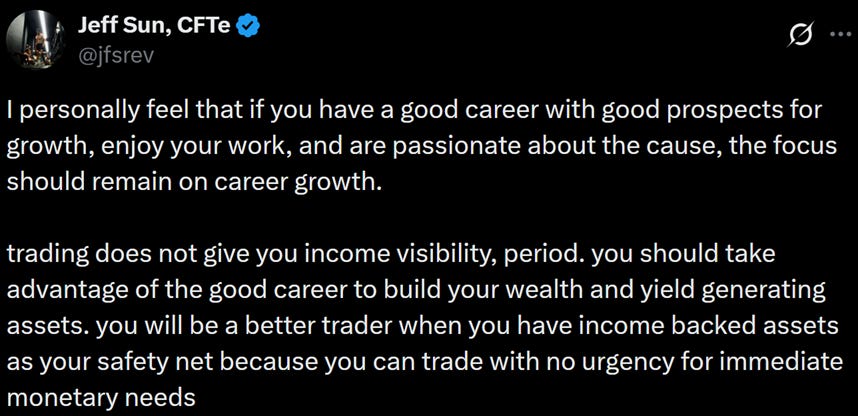
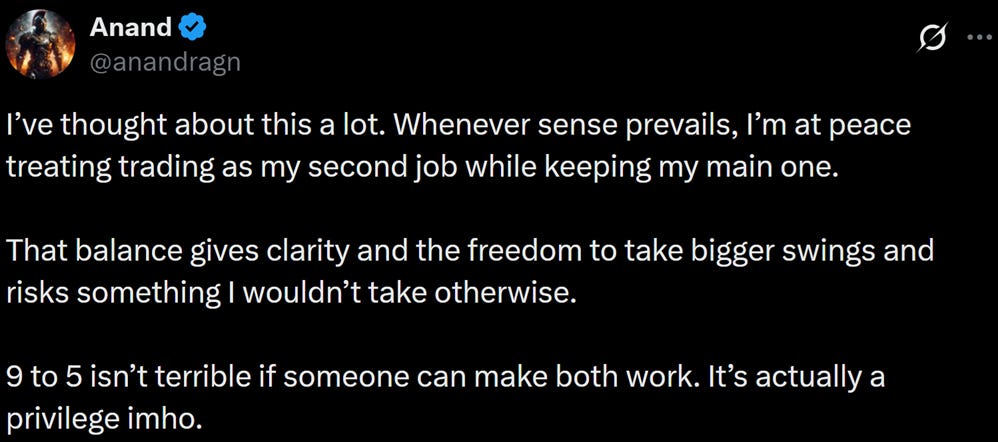
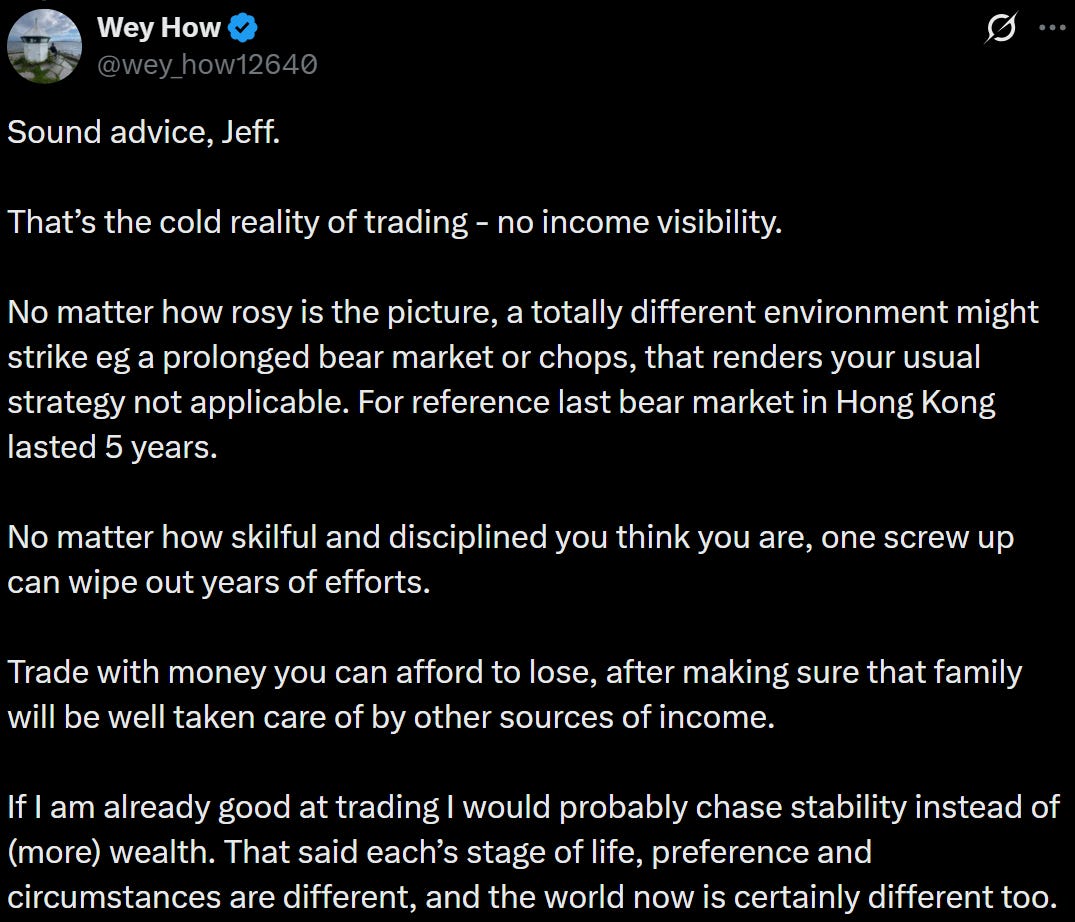
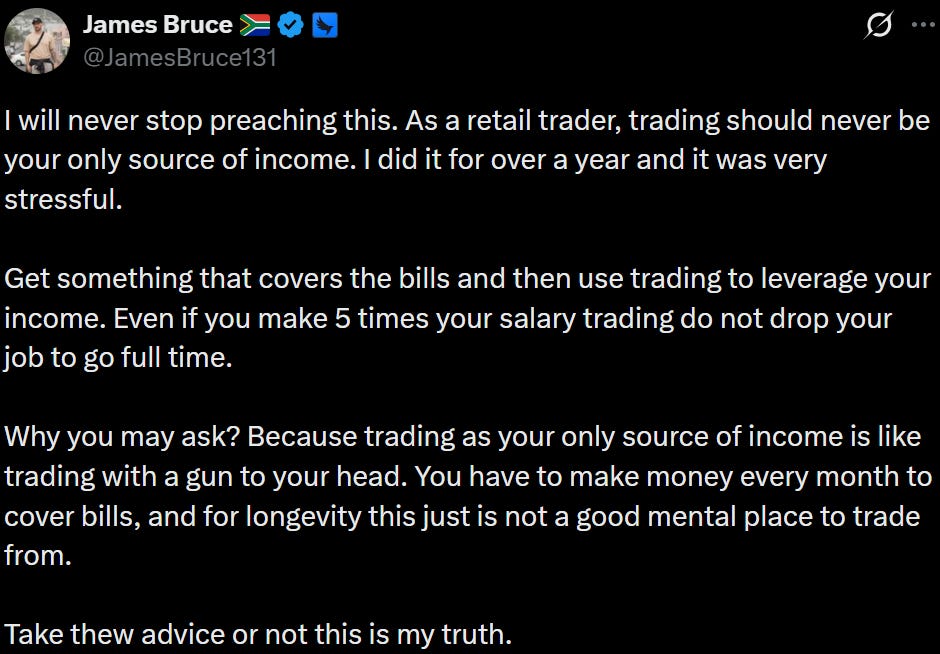
Part-time trading has significant advantages.
Yet many traders dream of going full time, focusing on the freedom while overlooking the benefits of staying part time:
It allows you to come from a position of strength, so you can focus on the process and skill development, not the money. This will help you make better decisions.
You have increased confidence because you’ve given yourself a layer of protection. As Sahil Bloom points out, confidence isn’t about knowing you’ll win, but knowing you’ll bounce back even if you don’t. (Don’t risk what you can’t afford to lose.)
The time constraint forces efficiency, extreme focus and intensity. It means you must focus on the activities that move the needle most — deliberate practice. And the more intense your practice, the faster your growth.
You reduce (or even eliminate) ‘random trades’, because you lack the time to stare at the charts all day. Plus, many traders anticipate their best trades days or even weeks in advance (myself included), so you’re not likely to miss them just because you can’t actively watch the market.
If your dream is to trade full time, what are you really after?
I understand wanting to work on your own terms. The benefits are numerous:
More flexibility
No pointless meetings
Higher earning potential
More stimulating/enjoyable work
More control over your environment
If this is what’s drawing you towards full-time trading, consider whether another option is possible: doing work you enjoy, while also trading.
This can mean self-employment. It can also mean employment with flexibility. Both can offer a safety net without hindering your trading.
Some people say that you lower your odds of success by giving yourself a ‘plan B’. I suggest you don’t accept this view at face value.

If you dig a little deeper, you’ll find that many of these people have some kind of backup: friends and family who’d help if you really needed it, substantial savings or inheritance money, a spouse with an income source, etc.
How can you both trade and do your day job well?
Clement Ang recently shared his routine when still trading part time:
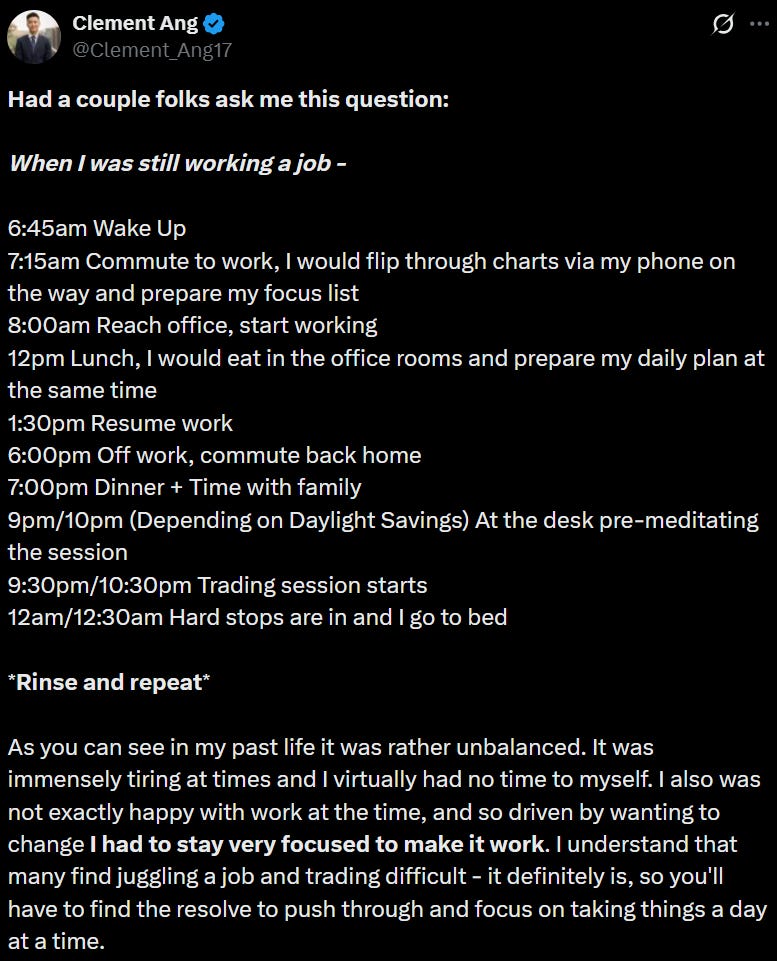
Clement’s circumstances were different to my own:
I actually liked my job — to the point that writing remains my priority. Trading comes second. (This obviously has a price. It’s one I’m willing to pay.)
The market usually opens at 14:30 for me, so during regular working hours.
I don’t have children, or even a partner.
Given that I worked from home for my day job since the pandemic, ‘quiet quitting’ wouldn’t have been difficult. (When you’re doing the bare minimum at work while focusing all your attention on your side hustle.)
But I never took this route. Dishonesty has never sat well with me.
Plus, you’re hurting yourself if you aren’t using your place of work as an opportunity to learn while getting paid.
Building up valuable skills gives you another layer of protection if your plan A doesn’t work out. Again, confidence is about knowing you’ll bounce back no matter what.
In addition, your employer is much more likely to accommodate any requests for flexibility if you’re valuable to them and can still perform your job with these changes. Working from home, long lunches, late starts and similar changes can all go a long way towards being able to pay attention to the market at critical hours.
But ‘being valuable’ is key — which, as a knowledge worker, means excelling at deep work.
Time management is everything.
The most productive knowledge workers are highly protective of their time. They avoid unnecessary meetings, prioritise high-value work, and batch work where possible — especially ‘shallow’ work.
I make a point of not wasting time, ever.
My highest-value work is writing. Especially the kind that requires deep thinking. So, I always aim to get this done before the market opens. Failing that, I continue in the late afternoon and evening, when I rarely place trades and mostly rely on alerts and hard stops.
From around 13:30–15:30, I get some lunch and fresh air, then watch the market. When still employed, it was generally accepted that I took a long lunch break, and besides, it was easy enough to keep my work laptop on in case of urgent messages.
Once the early activity in the market dies down, I’d return to work — usually doing easier tasks (like implementing comments) or conducting interviews (most experts preferred to talk at the end of their day).
I also avoided unnecessary meetings, and took breaks from deep writing work by dealing with (batched) emails or flipping through charts.You can make your 24 hours go further if you can complete deep work sessions, alternated with lighter work.
Both trading and knowledge work are about getting results, not ‘looking busy’.
Because I consistently produced more content than any other writer, to a high standard, my former employer would have been foolish to complain about my extracurricular activities.
And indeed, I never ran into any trouble where trading was concerned.
However, my employer wasn’t too happy with TTRH once it truly started taking off. (Although doing it casually is what landed me the job…)
The irony is that I only committed to TTRH like that because my employer taught me that job security doesn’t exist.
I’m immensely grateful for this lesson, and the brutal way it was taught, because it motivated me to keep pushing, no matter how tough the situation.
However, I was under extreme pressure to not just keep publishing weekly stacks at improving quality, but also overperform at work so I couldn’t be accused of slacking. For much of 2024, I carried on my ‘day’ job in the evenings — though rarely later than market close (21:00), when I’d flip through charts and write for TTRH.
I was certainly putting in the reps! And it showed in my rate of improvement, captured through my weekly stacks.
From July, my work changed. No data entry, more interviews, more ghostwriting. I loved the intellectual challenge, but due to the unchanged quantity, my hours got even worse. Until my resignation in November 2024, I worked into the evening every weekday, and wrote most TTRH stacks middle in the night on Thursdays.
Why work so hard for an employer who had little regard for my well-being, you might ask?

Simple: because the work was a large part of my deliberate practice. The more I did, the better my skill — and no one could take that away from me.
I got away with 4 hours’ sleep and never getting sick because I loved my work, ate well and exercised. Probably also through sheer determination.
Your commitment will be challenged.
So, how motivated are you?
Will you still show up if you’re sick, tired or invited to an event? Will you keep doing it when everyone (apart from those who matter) thinks you’re crazy?
Anyone who achieved unusual success went through a period of imbalance. If it was easy, everyone would be doing it.
Speaking for myself, I was prepared to make that sacrifice then. Your 20s is a good time to grind, especially if you haven’t started a family yet. The various pressures I was under ensured I improved quickly, and the sacrifice paid off.
Now, I still work hard, but fully on my own terms. And I continue to improve every single day.
Part-time trading removes the immediate financial pressure.
This makes it easier to focus on the outcome rather than the process.
But it also creates a different challenge: doing two jobs well. Full-time trading requires sacrifices. So does staying part time — although the sacrifices are different.
Either way, your commitment will be tested.
You’ll work when you’re tired. You’ll study when everyone else is relaxing. And you’ll constantly be told you’re crazy or that you work too hard, depending on the messenger.
There’s no easy path to extraordinary results.
Full-time traders sacrifice peace of mind. Part-time traders sacrifice time and energy.
Part-time trading might not be easier, but it does let you focus on process and skill-building, rather than chase results and worry about how the bills will be paid.
That’s the edge of the part-time trader — if you’re prepared to sacrifice and commit.
- Kyna


Very Nice read. I found a little disagreement with set hours to trade. That might increase ones tendency to actual trade during a set time when market conditions may not be ready.
Very nice article, Kyna with some practical insights. Being a part time trader I can relate to all the points you mentioned.
Personally I have also found that not being able to do my daily routine everyday will make me miss some opportunities but I have accepted that and made peace with it. I will generate less returns than full time folks and some highly committed part time folks and that’s ok. 😌