
How Writing Improves Your Clarity — And Your Trading
Reflecting on 3 years of TTRH

Three years ago today, I published my first stack.
In that time, TTRH has evolved — going from ‘straight’ note-taking, to connecting different resources, to creating original content both alone and with others.
But its core purpose remains unchanged:
Helping traders improve.
Mostly, that trader is myself. Create the content you wish existed!
When you write selfishly (but share selflessly), you write at your best: in a way that helps people like you the most.
This, incidentally, is common among honest traders who create content: they’re talking to themselves as much as anyone else. When you write to yourself, you know what needs to be said and how to say it.
The friction involved in that process gives you clarity — which is the essence of discretionary trading. In fact, even as a systematic trader, your edge depends on your judgement: which questions are worth asking? Which backtests are worth running?
However you trade, your judgement is perhaps your most valuable asset.
…but it can also be your biggest hindrance if you don’t trust it due to a lack of clarity.
Whether you lack clarity in your edge, what price is telling you, or your own strengths and weaknesses, they all lead to poor decision-making. And poor decisions in an endeavour that inevitably involves suboptimal decision-making — and where you can see exactly how suboptimal each decision was — can be deadly.
Ideas that solely ‘live’ in your head tend to feel comfortable. Perfect, even.
But they’ll also remain fuzzy. It’s a bit like traders who buy stocks without a clear exit plan, but only have a vague idea to ‘trail with a moving average’, then end up selling at the worst possible time.
Writing crystalises ideas.
It takes them from the comfort of your head into the cold, hard reality where you truly start getting clarity about those ideas and their uncomfortable implications.
Selling into strength means leaving money on the table. Selling into weakness (i.e. trailing your stop) means giving back profits. The emotions of participants means price action can be irrational. And the randomness of the markets means even Dan Zanger doesn’t know in advance which stocks will turn out to be the big winners.
You can only make peace with suboptimal outcomes if you fully understand that they’re necessary for your strategy to work. (An edge that always worked would quickly be eroded.)
When you know what to expect, you can prepare yourself for it.
Dig into the purpose of certain rules:
What positive outcome do they unlock or catastrophic outcome do they prevent?
What are their drawbacks?
Why are those drawbacks worth it? What is the expectancy?
What makes you confident the edge is repeatable? What is the basis in market structure?
When you dig into such questions and write down the answers in a way someone else can understand them, you’re forcing yourself to gain a level of clarity — and with it, conviction — difficult to obtain any other way.
Because writing = thinking.
…which means it’s all about the process.
While you may delight many people with your output — and that’s a privilege I’ll never take for granted — the real value comes from the wrestle it took to create it.
It’s easy to do lots of reading and listening, even taking notes, thinking that you’re learning a ton.
But the true test comes from trying to put those notes together, blending them with your own insights, arranging them in a way that could teach yourself (or someone else).
Just like with chart annotation, there’s no one right way to do this.
What exactly are you trying to achieve?
Are you writing to work through a question?
Are you keeping records to document your growth while finding further opportunities for improvement?
Are you using it to stay accountable to your process?
There’s more than one way you can achieve clarity.
For that matter, there’s more than one way you can study, as the study series with (so far) Kohei Yamada, Clement Ang and Martin Luk has shown. These three traders take different approaches, but with one big thing in common:
Intentionality.
Deep study = intentionality + a routine that works for you + lots of focused reps.
You can’t get around certain types of deliberate practice. For example, you won’t be much of a technician if you don’t flip through plenty of charts. You’ll have a hard time fixing your mistakes if you don’t review your trades.
But beyond that, I’d argue that consistency is most important. And that’s easiest when you love the process itself. Whatever mundane tasks you can fall in love with, while ensuring intentionality — a method to improve your clarity — do that. Intensity is only sustainable if you also make it fun.
Don’t listen to anyone who discourages you. In my first year of TTRH, I frequently got mocked over how “no real trader would put so much effort into writing”.
My response was to put even more effort into my writing and especially my research, which seems to have silenced the critics. Better yet, more and more traders openly share how much writing has improved their trading because of the clarity it gives them.
Writing naturally forces you to slow down and look inward.
It also naturally lends itself towards going into more depth. Both will only become greater edges as more people attempt to use AI to skip the process.
You’ll get what you want out of your writing.
Wrestling with ideas is hard. But going through the struggle is how you learn, grow and feel proud about the end result — and is what gives life meaning.
As the stoics said: the obstacle is the way.
The friction of writing forces thinking.
Even something as simple as manually logging your trades can be valuable. When I started logging mine in Excel, if I felt reluctant to log a trade, that meant I shouldn’t have taken it — because it didn’t fit my rules.
Whenever I then reviewed my trades, they remained in my journal, staring me in the face. Painful. Combined with the gut-punch whenever I had to log such trades, I soon stopped taking them.
Another simple suggestion is to write down your strategy in a way someone else can understand. It’s a great test to see whether you really understand it as well as you think.
The same applies to explaining foundational concepts. For example, try writing about market structure. It’s a topic you think you know — but when you attempt to explain it to someone else, in detail, without tolerating gaps or contradictions, you may well find yourself humbled. I repeatedly have. But the process (or stress-test) of writing deepens my understanding.
And I always come out the other side both humbled and a little wiser.
TTRH started with Qullamaggie stream notes and other ‘direct’ notes.
…but I was never a fan of bulleted highlights or just combining screenshots with quotes.
While I wouldn’t describe my early work as ‘deep dives’, I did try to capture as much useful detail as possible. That approach helped me catch a lot of the surface layer (i.e. the ‘what’) — particularly because I frequently paused the recordings to study the screen — but I wasn’t yet proactively asking questions about the ‘how’ and ‘why’.
As I published more and more stacks, I noticed how certain principles kept cropping up. I also noticed how the same person would contradict themselves between videos, which prompted me to ask more questions.
On top of that, because I had readers from the start, people were sending me questions that I couldn’t answer. But because I felt I should be able to, I dug deeper. That mentality also made me more ‘interrogative’ when (re)visiting books or videos.
That’s how I started blending insights.
It became increasingly common for me to reference multiple traders in the same stack. And as I thought harder about the core principles that remained unchanged across all top performers — including outside trading — I started producing more original work.
The first one was “3 Core Principles to an Edge”. That also happened to be the last stack I published under my pseudonym, Kay Klingson, and the first stack I largely ‘wrote’ while out walking. The idea of writing away from my computer was a revelation for me at the time.
A few weeks after that, I introduced the term ‘deliberate practice’ to the trading world (but I learnt the term from Cal Newport).
That period moved my 50/50 focus on research and writing to emphasising research.
This became more extreme as I left my day job and spent most, and later all, of my time collaborating with traders.
But whether I have direct access to the trader or not, I now spend significant time pulling the person’s writing or transcripts apart, then reassembling them, asking a lot of questions along the way.
This gives me deep insight into how the person thinks — very useful as a ghostwriter, but also as a trader. It improves my clarity into the foundational concepts that truly matter, helps me see important nuances, and generates ideas for adapting core concepts to your own needs.
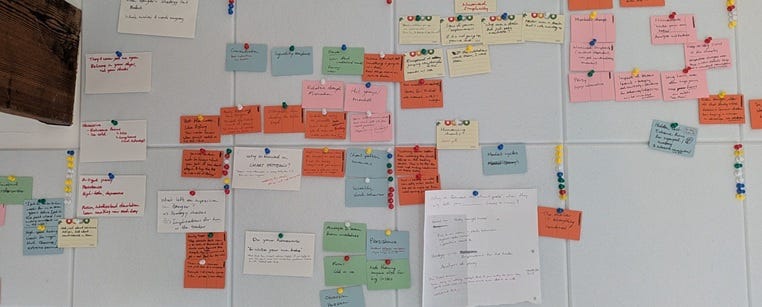
Another step in my research involves noting down key insights on small cards and shuffling them around on my pinboard. This process helps me join more dots and identify potential gaps — the photo above is only a section of what my pinboard looked like towards the end of the recent Dan Zanger deep dive.
…which brings us to a common question:
How do I organise my research into a coherent write-up?
Would you believe me if I told you I’m not quite sure myself?
I just have faith that it’ll somehow come together — because it always does. (And because I’ll patiently rewrite as many times as it takes.)
But I typically do know two things going into a write-up:
The main points I want to cover. (By this stage, they’ll be on my pinboard.)
Where I’ll start. (Working title and subtitle help with this.)
Because I know where the piece begins — often related to why I’m writing it in the first place and why you might want to read it — I just start writing, then see where I end up. I rarely use traditional ‘signpost’ headings, but integrate them as part of the main text, which allows the words to flow uninterrupted.
That reflects how I try to write.
I go over that opening idea, covering whatever I’d planned to address, and as that idea concludes, I see a clear ‘link’ to the next idea.
And sometimes, that’s how the writing actually happens. Quite a few articles for clients were produced that way. So were some TTRH stacks, like “Trading Inevitably Involves Suboptimal Decision-Making”.
But often, the reality isn’t such smooth sailing. Particularly for the true deep dives.
As I write, new patterns or connections occur. Or I’m trying to explain something in a simple way, but am struggling to communicate the idea clearly. Or I realise that I’m explaining something twice, so need to combine those segments. (Long form must have a high WWR, or ‘word-to-wisdom ratio’, to work as a newsletter. It’s also how you increase clarity into the core ideas.)
But I also know that if I just wrestle through the process, I’ll eventually finish.
…and I’ll come out the other side with clarity I didn’t have going into the project.
Is this approach, objectively speaking, less efficient than other study methods? Definitely.
Is it less effective than other methods? I think that depends on the person. Writing has been a game-changer for other traders. And it’s been highly effective for me — because I combine intensity with fun, which is what makes it sustainable!
I don’t doubt that the cumulative effect has helped my trading.
But over the three years, some individual stacks represented huge ‘aha’ moments for me through the process of producing them. (And were not a write-up of an ‘aha’ moment that happened outside TTRH.)
My top ‘aha’ stacks.
(In chronological order.)
Situational Awareness and EPs
Collaborating with Anthony Shi completely changed how I understood market cycles. Plus, via our second collaboration just two weeks later, he made me see how the different setups all interrelate and he planted the seeds for understanding the psychology behind certain nuances, like neglect.
Still a TTRH highlight for me. (And still #1 in the all-time archive.)
6 Criteria for Explosive EPs
Building on my work with Anthony, when I dug into Stockbee’s work on criteria for explosive EPs, this completed the ‘puzzle’.
I didn’t just understand EPs better, but realised how different setups are more similar than I previously thought. It also showed the importance of stacking edges, from bigger things to the finer details. A massive ‘aha’ moment for me.
Aggression in Trading
I’m naturally risk averse (and spent seven years working in GRC, or ‘governance, risk and compliance’), so have found it hard to learn to get aggressive. In this collaboration with Clement Ang, we explored what getting aggressive really meant.
Crucially, I realised that it’s just the flip side of playing defence. If you’re protecting your downside, it doesn’t make sense to not get aggressive — otherwise, what’s the point of taking the risk to begin with?
Working on this stack with Clement made me intellectually understand this, but it wasn’t until several months later when a harsh lesson from my now-former employer got me over that mental ‘hump’ to actually be comfortable with aggressive trading.
Risk and Position Management With Jeff Sun
In this stack, I gathered several tweets from Jeff Sun, CFTe about rules I already knew (like selling partials and trailing with the moving averages), but then completely dissected and reassembled them.
That process internalised the ‘why’ behind those rules for me. I stopped seeing taking a partial as a cop-out and got better at holding stocks for longer from that point forward. It also reiterated the importance of digging into that ‘why’ — something I’ve been repeating from that moment onwards.
Market Cycle Analysis, Strategy Adjustment and Risk Management
Theo Gustincic’s guest post. His first draft displayed such advanced, fluid thinking that it forced me to level up my own when working my editorial magic.
I only intellectually understood that market environment and risk management interlink, but still discussed the two separately. But Theo didn’t even need to think about this. They’re so ingrained in his processes that focusing on just one in his writing meant, to him, addressing both.
From working with him, I internalised that establishing the environment is, to a large extent, risk management. (I discussed the process in more detail here.)
How to Build and Maintain Watchlists
In this guest post from Clement Ang, my intensive editing processes once again forced me to learn how the person thinks. That made me realise I was looking at another example of what I’d later call Nuanced Simplicity.
You get told to focus on your universe of stocks, and learn about progressive exposure, situational awareness, themes, and so on, but that quickly becomes overwhelming. Instead, you process all those moving parts by focusing on just one, or a small number of, questions — in this case, what are the odds of your edge currently working?
Combined with my other experiences of working with and studying top traders, I finally realised this is what makes them perceive their strategy as simple — even if, technically speaking, it’s not.
Martin Luk’s Low-Friction Study Process
My second collaboration with Martin Luk — about how he studies — was another ‘aha’ moment waiting to happen from earlier groundwork.
I’d researched or worked with so many traders who attributed much of their success to quantity (for example, flipping through thousands of charts), the contrast with Martin made clear just how important intentionality is when you’re studying.
Because I discuss deliberate practice so much, I basically already knew this, yet I’d also been seeing friction and quantity as other key parts of that ‘study success’ equation. Working with Martin showed me that my assumptions needed refining.
My writing style is a bit like doing a puzzle without the box.
You don’t know what pieces you’ll uncover, how many there are, or how they fit together.
But figuring this out is the process. To me, that is writing (as well as the essence of reverse-engineering).
When you interrogate the ‘how’ and ‘why’, you increase your clarity. In turn, that improves the quality of your judgement and decision-making, which directly impacts your trading success. And because writing naturally forces you to slow down and go deep, it lends itself well to achieving that clarity.
You don’t need to turn writing into an art form to benefit from it.
Just use it as a tool to gain more clarity into the markets, your edge and yourself — if only through journaling, so you look inward more and can identify further areas for improvement (as well as keep records of your progress).
However, I’ll continue to use TTRH as a place to study the art of trading while practising the craft of writing :)
But I never dreamt what started as a side project would grow the way it has. And I never imagined I’d meet so many inspirational people along the way, never mind collaborate with them.
What a journey. Thank you for joining me on it.
- Kyna
This is spot on. I’ve been struggling with presenting my ideas in a linear way when it comes to longer articles. I'm hopeful as I write more and more this will get better.
Writing IS thinking! Great article and congratulations on the big 3.