
How to Make Borrowed Ideas Potent
From idea generation, to clarity, to refinement

Many traders want someone else’s strategy.
Hardly anyone wants to dig into how they arrived at that strategy.
No system is perfect — which makes losing trades unavoidable.
Operating it under such conditions without complete clarity into how and why it works is impossible. Even with that clarity, you can’t operate the system if it doesn’t suit you.
And if it suits you and you understand its mechanics?
Then operating it is merely uncomfortable.
Finding a system is the easy part.
Making that system work for you necessarily involves discomfort.
You don’t need to reinvent the wheel. Just learning how to make ideas that resonate potent for your own needs is enough if you can work through three phases:
1. IDEA GENERATION
Stand on the shoulders of giants… but once you have a direction, switch from broad to deep.
Coming across a tangible nugget is satisfying.
Whether it’s on social media, from a podcast or book, or a pre-made model book or deep dive, you feel like you come away with something valuable.
These days, you can even get that feeling from using AI. How many traders built impressive-looking dashboards this year?!
The danger lies in constantly chasing more ideas rather than work with the ones you already have.
More ideas doesn’t equal making progress.
In fact, many traders discover the opposite. As time passes, they often look to simplify their system, stripping out the excess and generally just trading less.
…because they increasingly realise what moves — and doesn’t move — the needle.
That doesn’t mean AI or software can’t add value to your workflow. For example, I use AI to find more stocks belonging to a theme to help with watchlist-building.
But you can’t get around the need for intentionality.
There’s a huge misconception that the point of a deep dive is the output, like a model book.
That’s why you see dedicated software popping up. The kind that claims: “Qullamaggie told you to do a deep dive; here’s the tool to do it”. (This is the real method Kristjan used. Don’t click the link if you’re looking for a shortcut.)
That’s also why people try to build such deep dives, or take other notes, with AI. Which is like saying that real-time translation earbuds are as good as actually learning the language.
The point is the process.
Going through that struggle is the only meaningful way to learn and grow.
The process is what builds your mental network. It’s how you learn pattern recognition through the lens of your edge.
The output is just the tangible part, useful for later review (for reinforcement and finding areas for improvement with fresh eyes). Also useful for getting engagement on social media, or even packaging and selling to people. But not actually required to achieve Martin Luk returns.
In fact, no successful trader credited their success to a tool that did the studying for them. They credit it to studying themselves. (Though often directed by those who did a similar study before them — idea generation!)
That alone speaks volumes.
You can’t borrow conviction.
You can’t even build conviction by carefully studying someone else’s model book.
A huge part of trading comes down to information filtering, based on your edge.
Some successful traders have been using their automated Excel dashboards for years, but they still feel the real work is manual. Their dashboard just gives them a top-down overview and confirms they’re reading the market correctly…
…but it doesn’t give the level of clarity that comes from deliberate practice. From their own information filters.
This doesn’t change just because the tools have become more advanced.
Handwriting vs typing illustrates the value of deliberate effort well.
Most people know they retain more from handwriting than from typing, but don’t always understand why — or that the reasons are multifold.
An obvious one is that the friction involved with writing makes you more selective about what you write down to begin with. Especially when taking notes.
A deeper reason is that the different physical movements required to handwrite different-shaped letters means your brain is solving different spatial problems. You’re literally demanding more activity from more parts of your brain as you’re processing the information, whereas typing requires largely the same movement for each letter, lowering brain activity.
Of course, typing also has advantages, so know when to wield which tool. Just keep in mind that the ‘faster’ route may actually be the long road in disguise.
Deliberate practice truly is the shortcut no one wants to hear.
Others can tell you where to look.
Read books. Listen to interviews. Study a few annotated charts.
…but recognise that all that information is already filtered, through someone else’s lens.
They can all point you in the right direction, from a starting method to the key concepts to study. But to make other people’s ideas potent for you, you must learn to filter information through the lens of your strategy, reflecting your personality.
This requires patience and focus. It requires curiosity. And it requires problem-solving, from figuring out why certain things you encounter don’t quite add up, to learning how you can exploit your findings.
When perfect ideas don’t exist, you must learn to make imperfect ideas work for you.
2. IDEA CLARITY
When you have an idea that resonates, dig deeper. Face the friction head-on.
The obstacle is the way.
The stoics had it right: resistance gives your brain a reason to change. If you avoid it, you’re keeping yourself stuck in the idea generation loop.
But when you push yourself to get uncomfortable, magic may happen.
As you figure out the mechanics of an idea so you can make it your own (or make an informed decision to dismiss it), ask questions.
Allow your curiosity to guide you.
From reviewing your own performance based on your journal to identify areas for improvement, to reverse-engineering the system (and thinking) of another trader, a curious mind is always learning.
Curiosity also helps you enjoy the hard work of finding your own answers. And being able to alchemise challenging work into fulfilment is, in itself, an edge.
That curiosity also directs your questions as you reverse-engineer someone’s ideas:
Why are they doing X? Why is X important?
Why aren’t they doing Y? Isn’t that the logical next step?
X and Y appear the same to me, but they treat them as different. What are they seeing that I’m missing?
X and Y seem to contradict one another. How can both be true? (My Dan Zanger deep dive gives several examples, illustrating the importance of nuance and context.)
How do they make the jump from X to Y?
My experience of collaborating with top performers, by the way, has taught me that they themselves don’t always have an answer to hand.
But you can help them reverse-engineer their own thinking, and bridge intuition gaps, by asking specific questions that address the above points. In Brian Shannon’s words from a new video testimonial:
“She asks insightful questions that help me clarify and even understand my own concepts better than I did before talking to her.”
Matt Petrallia has also given me a new testimonial, explaining my (ghost)writing process in more detail.
Imitate before you innovate…
…but focus on copying the person’s actions that helped them develop their system rather than the output.
Going through the same discovery process, but through your personal lens, helps you understand both the mechanics of the system and the ‘levers’ available to you to play with it. This allows you to refine and adapt it to your own needs. Over time, you may even make it more potent for you than for the person who gave you the idea.
But before you think about personalisation, focus on gaining true clarity into the mechanics of the edge — and therefore your strategy.
Without that clarity, the market will constantly be ‘advertising’ trades to you.
…which is just inviting problems like overtrading.
One of the best ways to stay disciplined is to have absolute clarity on what you need to see for the probabilities to be stacked in your favour. What scenario would warrant taking on the risk? By extension, any other scenario requires you to protect your capital. It’s the only action that makes sense if you treat your trading like a business.
This clarity may not eliminate all your discipline-related issues, but it’ll go a long way towards improving them.
Another root cause to this symptom is unrealistic expectations, again, due to a lack of clarity.
Do you truly understand that trading inevitably involves suboptimal decision-making?
Do you know that, if your strategy is to trail with a moving average, you’ll give back unrealised gains? Do you know that, if your strategy is to sell into strength, you’ll leave money on the table? And if you do know these things, why do you act surprised when that’s exactly what happens? (Question for you to ponder.)
As another example, do you actually know your odds of a prolonged losing streak? For example, my win rate this year so far is 25%. Over 50 trades, mathematically, my odds of getting 5 losers in a row is 96%. A near-certainty.
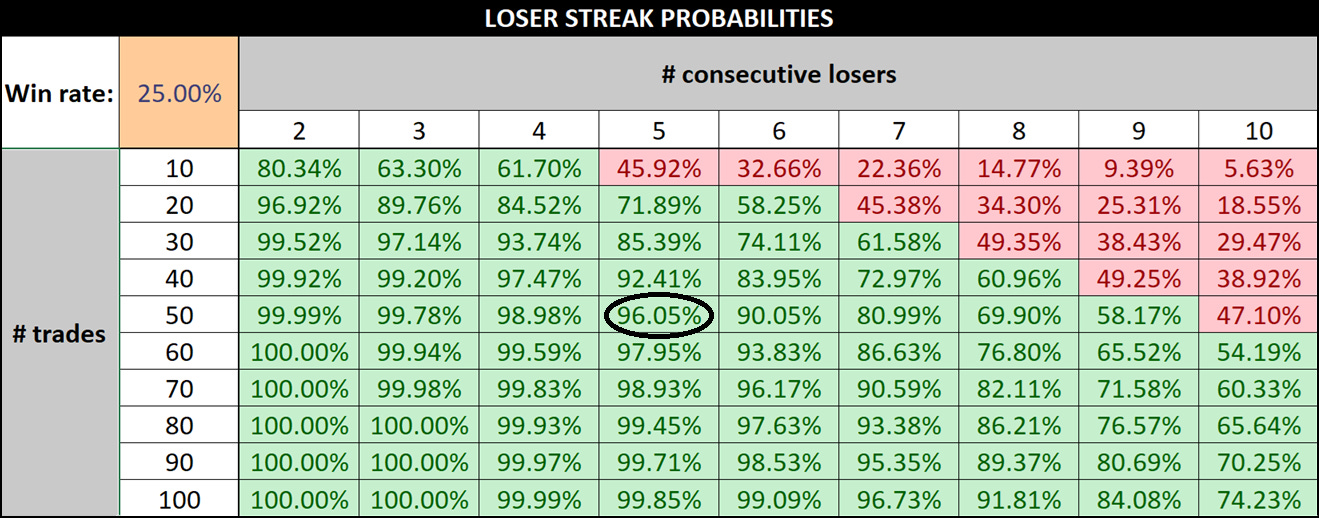
Of course, in practice, my strategy is so dependent on the right environment that 5 losses in a row is telling me something meaningful. Particularly when combined with poor price action from stocks on my watchlist.
But earlier in my journey, knowing these stats helped set my expectations and showed me how I couldn’t afford to take excessive risk per trade when losing streaks are a mathematical certainty.
Speaking of environment…
What do you notice when you do a deep dive into your setup?
When you don’t just study a pattern, but also its context, you’ll realise how its odds of success vary depending on the market cycle.
In fact, when you dig into market cycles themselves, you’ll see how different setups work best at different stages of the cycle. Deep study will also help you see the significance of theme and relative strength. Plus, experience will teach you the importance of stock personality, based on factors like liquidity and volatility.
But until you gain that clarity, you’ll remain prone to taking that setup no matter the context — including when your odds are poor. Which makes you more likely to dismiss the idea as ‘wrong’ when the true issue may be a lack of clarity.
Operating your system will never be comfortable. But without intimate knowledge of how and why it works, operating it with consistency is impossible.
3. IDEA REFINEMENT
With clarity on the mechanics, you can play with the ‘levers’ to truly make the idea your own.
Knowing the inner workings of the idea, can you make it potent for you?
Some ideas may work for others but just don’t make sense for you.
And there’s nothing wrong with deciding to not use something, as long as it’s based on proper reasoning and not an expected obstacle. (This guest post from Kohei Yamada helps you think more critically about ‘common wisdom’.)
But where the idea fits your purposes, you must make it your own to be able to stick with it when it inevitably leads to suboptimal outcomes.
In fact, you may need to adapt it to even make it work to begin with.
From my reader stories, a great example is Daniel Marks. He’s unable to watch the market open, but inspired by Jeff Sun, he wanted to trade opening-range breaks based on definable characteristics.
This made Daniel think he could develop a script to execute the trade where the rules are met, on the stocks he manually selected earlier that day.
With AI, he then developed that script, which he was still testing at the time of publication — but it shows the problem-solving mindset necessary to succeed as a trader.
Daniel’s experience inspired me to use AI to customise my charts.
I wanted to become more systematic about selling partials into strength, and knew the value of Jeff’s 10 ATRx indicator. But as a TC2000 user, I couldn’t add it directly to my charts.
Then, I had the idea to add conditional formatting instead, and switch from candles to OHLC bars — a change I’d already made on my intraday charts thanks to Brian Shannon’s influence. I figured out how to add the 10 ATRx, then went a step further and also added conditional formatting for 4 ATRx and 7.5 ATRx.
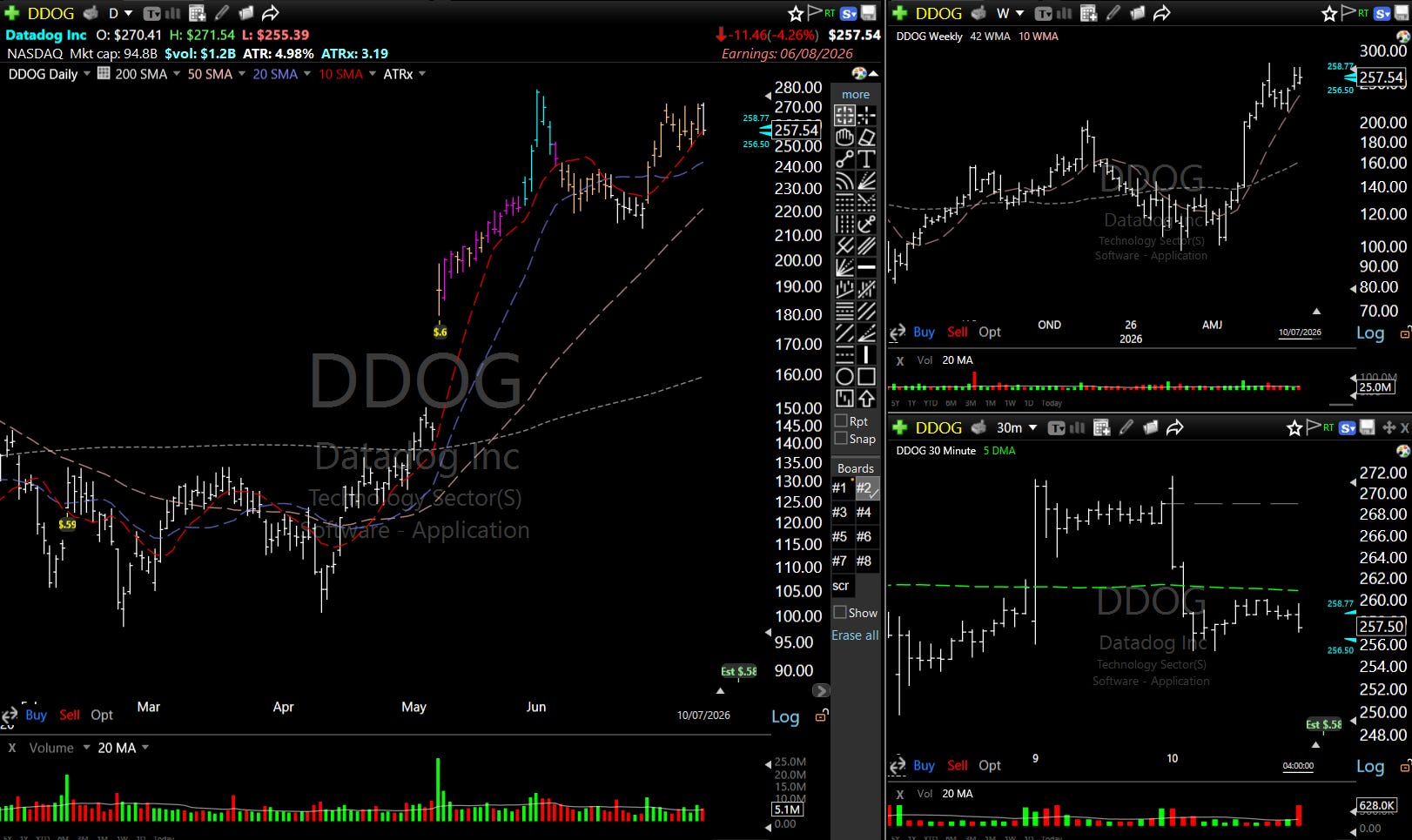
Fast-forward a year, and I still find this layout valuable, especially the orange 4 ATRx marker. It’s a great visual reminder that my current odds of the trade working (especially for a bigger move) are reduced.
Many other traders from the reader story series took inspiration from others to solve their problems.
For example, Khoa Nguyen knew he needed to review his performance, but couldn’t figure out how to go about it — until he stumbled across Mike Bellafiore’s The Playbook and a video with Lance Breitstein about the daily ‘Report Card’.
Khoa then adapted those ideas to himself (he shared how in his story), giving him the accountability and feedback loop he needed to treat his trading like a business.
Another trader from the same series, Simon, shared how Jeff Sun inspired him to build his own market spreadsheet in Excel that — like with Khoa’s playbook — gave him the structure and accountability he needed to thoroughly prepare for each session.
The pattern continues with Kai Hamill, Maikel Wenting, Bertus TenBrinke, and other guests from the series.
They identified their problems by reviewing their performance, figured out the root causes, then found solutions to those problems by taking inspiration from others and adapting those ideas to their own needs.
Critical elements are your own data and introspection. Big ‘aha’ moments tend to come from matching up patterns within your trading data with:
Ideas you’ve encountered in a book or another resource.
Your patterns in other areas of your life.
If you’re an airline pilot like Bertus, for example, chances are that cutting losses comes naturally to you. Meanwhile, Maikel recognised that his refusal to accept defeat extended beyond his trading and into other competitive areas of his life.
For both strengths and weaknesses, you need the “that makes sense!” moment to spark lasting change.
Besides mitigating personal weaknesses and exploiting strengths, also consider your constraints and overall goals. If you can’t or don’t want to watch the market throughout the session, for example, day trading is out of the question.
Personally, I’ve been gradually lengthening my timeframe from swing to position trading (I’m somewhere in the middle now). Because I’ve made a conscious decision to make writing my priority, but also want to carry on trading and slowly compound my account, the longer timeframe makes more sense for me.
And actually, I’ve found sitting in trades for longer to be more comfortable than expected. The simplicity of the approach helps, along with framing it as ‘letting the market decide’ (based on the 20 MA).
This has taken the decision-making pressure off me — all I need to do is follow the plan I’d prepared before taking on the risk. (But it’s also given me new challenges to address.)
The clearer my rules and plan, the easier they are to follow.
Other traders have made similar observations: by being crystal-clear on their edge and making their system as precise as possible (even as a discretionary trader), rule-breaking becomes far less likely.
And that, too, is a form of idea refinement.
But it always starts with idea generation, followed by clarity into the mechanics of the idea, which — combined with clarity into yourself — you then use to truly make the idea your own.
You don’t need to reinvent the wheel. Just learn how to borrow ideas, then make them potent for you.
- Kyna


Hi Kyna, thanks again for this amazing and deep article. You are one of my Top3 readings. Congratulations!! Keep the good work. Regards from Portugal. Nuno
Thanks for sharing this abstract from Maikel. I can definitely see the value in writing some statement like that for constant reminder until I truly internalize it.